
The Calm Before the Whiplash
Sailing for 17 years around the world taught Dee and me countless lessons, but one of the biggest was this:
Your emotional weather can change faster than the actual weather.
We were sailing off the coast of Colombia, heading toward Panama after days of rough, boisterous sailing. The big seas that had tossed us around were finally beginning to settle. The wind softened, the sky cleared, and for the first time in days, the ocean felt graceful instead of combative.
It was the perfect moment to raise the spinnaker — the big, bright, balloon-like sail you see in magazine photos. Even non-sailors know this sail: it’s the joyful one, the one that makes a boat look like it’s flying.
We hoisted it, watched it fill with wind, and for a few blissful minutes, everything felt perfect. The boat surged forward. The sea had a rhythm again. The colors of the sail glowed against the sky.
After days of just hanging on, we were finally able to breathe.
And that’s when life did what life loves to do: it changed the script.
Chaos in an Instant
With no warning, the halyard holding up our mainsail snapped.
For non-sailors, think of this as the rope that keeps one of the boat’s main wings in the air. When it breaks, everything collapses. Instantly.
One second we were gliding.
The next, the mainsail crashed down onto the deck in a tangled heap.
We had to pull down the spinnaker immediately — a delicate, easily torn sail in conditions like this — and without any sails up, the boat lost its balance and began rolling violently, side to side, like a washing machine on spin cycle.
The long spinnaker pole was still sticking out from the side of the boat like an outstretched metal arm — dangerous to us, dangerous to the boat, and unpredictable in the chaos.
In an instant, we went from peace and beauty to full-on survival mode.
Every sailor knows the thought that came next:
Why, exactly, are we doing this?
Whose idea was it to go sailing anyway?
We were cursing our decisions, cursing the ocean, and maybe even cursing each other — the way people do when exhaustion, adrenaline, and fear collide all at once.
Before I could even begin the repair, I had to somehow wrestle in that heavy pole — a dangerous job even on calm days, let alone in violent, unpredictable motion.
And then—
the ocean reminded us she has a sense of humor.
The Dolphins Arrive
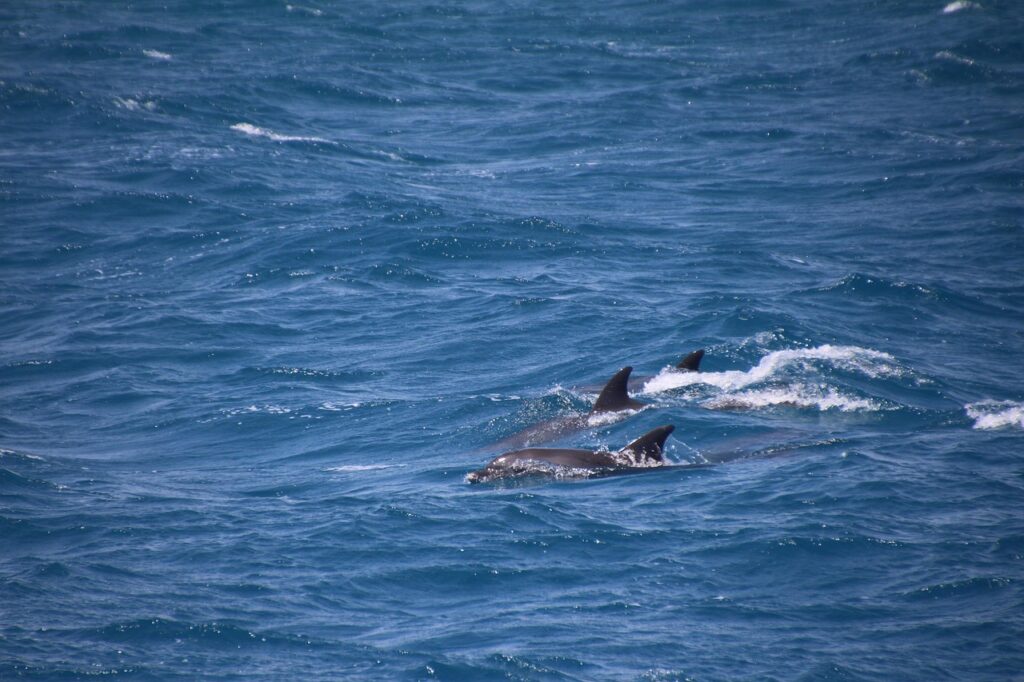
Just as I steadied myself to grab the pole, we saw something slicing through the water beside us.
A wake.
Then another.
Then several more — fast, smooth, torpedo-like trails.
A moment later, a dolphin launched itself out of the water.
Not just a leap —
a performance.
It arced toward the pole sticking out from our boat as if it were trying to jump over it like a high jumper.
Then another dolphin followed.
Then another.
For the next ten minutes, a pod of eight or ten dolphins put on a private SeaWorld-level show — just for us, just for that moment, just because they felt like it.
They leapt.
They twisted.
They tagged the pole with their noses.
They raced each other through the waves.
They played.
And we stood there — two grown adults on a violently rolling boat, not fixing anything, not solving anything — just laughing with pure, unfiltered joy.
Fifteen minutes earlier, we were swearing at the ocean.
Now, we were grateful for it.
Fifteen minutes earlier, we questioned why we ever chose this life.
Now, it felt like the greatest gift in the world.
That’s the magic of moments like these:
Life can go from the worst of times to the best of times in the blink of an eye.
What This Moment Really Meant
That day taught us something we’ve relied on ever since — across storms, business failures, leadership challenges, and personal hardships:
Chaos and wonder often live right next to each other.
If you quit too early, you miss the miracle.
Had the halyard not broken…
Had the boat not rolled…
Had we not been thrown off balance — literally and emotionally —
we never would have seen that show.
The dolphins didn’t fix our problem.
They fixed our perspective.
And perspective — not conditions — determines your quality of life.
Leadership is the same way.
Happiness is the same way.
Resilience is the same way.
When things go wrong — when the halyard breaks, the seas turn, the plan collapses — most people get trapped in the story of disaster.
But if you can stay open, even for a moment, life often offers something unexpected:
beauty, meaning, insight, connection…
sometimes even dolphins.
Why This Matters for Leaders
In organizations, “broken halyards” happen daily:
A key employee quits.
A project collapses.
Budgets get slashed.
Technology fails.
Markets shift.
Plan A falls apart.
Leaders often react the same way we did on that boat:
- frustration
- fear
- blame
- regret
- second-guessing
But great leaders learn to look up.
To widen the frame.
To ask themselves:
“What else might be happening right now?
Where is the opportunity in this disruption?
What perspective am I missing?”
Teams mirror the emotional state of their leaders.
If a leader can maintain curiosity instead of panic, openness instead of despair, presence instead of catastrophe-thinking, the entire culture stabilizes.
And often — on the other side of the chaos — something extraordinary emerges:
a breakthrough idea,
a new direction,
a better solution,
a deeper connection,
a moment of awe,
or simply a reminder of why the work matters.
How to Apply This in Your Life (Starting Now)
Step 1: When chaos hits, pause before reacting
Your first reaction is almost always emotional, not accurate.
Take a breath.
Anchor yourself.
Don’t let the story you tell in the first 30 seconds dictate the next 30 days.
Step 2: Ask, “What else could this mean?”
This question opens the door to alternative interpretations, unexpected opportunities, or a reframing that shifts everything.
Step 3: Look for the dolphins
Not literally — though that would be great.
Look for the unexpected moment of beauty, humor, grace, or connection that almost always appears when your plans fall apart.
They’re always there.
Just not where you expect them.
Final Thought: Awe Is Always Closer Than You Think
That day off the coast of Colombia changed us.
Not because of the broken halyard.
Not because of the chaos.
But because of what came next.
We learned that life isn’t a straight line.
It’s a series of emotional whiplashes —
frustration to wonder,
despair to joy,
storm to clarity,
chaos to magic.
And if you stay open —
if you don’t shut down or give up in the middle of the storm —
you get to experience the moments that make life breathtaking.
Worst of times… best of times.
Sometimes all in the same afternoon.